
Cannabis contains over 100 cannabinoids, but three dominate the conversation: THC, CBD, and CBG. Each interacts differently with your body’s endocannabinoid system (ECS), leading to very different effects, benefits, and risks.
If you’ve ever wondered what these cannabinoids actually do, this guide breaks it down clearly—backed by current research.
What Are Cannabinoids?
Cannabinoids are naturally occurring compounds in cannabis that interact with the body’s ECS—a network of receptors (CB1 and CB2) that help regulate:
-
Mood
-
Pain
-
Appetite
-
Sleep
-
Immune response
Each cannabinoid affects these systems in a unique way depending on how it binds (or doesn’t bind) to these receptors.
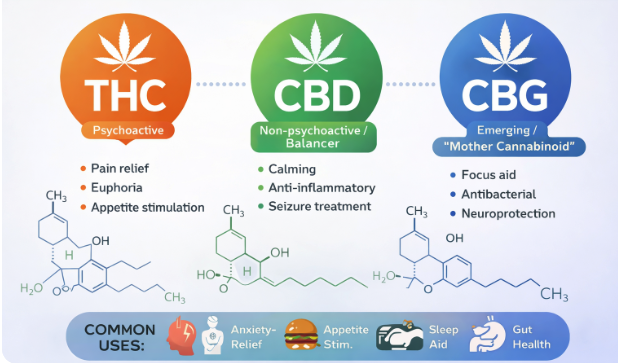
THC (Tetrahydrocannabinol): The Psychoactive One
What It Does
THC is the primary psychoactive compound in cannabis—the one responsible for the “high.”
-
Binds strongly to CB1 receptors in the brain
-
Alters mood, perception, and cognition
-
Produces euphoria, relaxation, and sensory enhancement
Potential Benefits
-
Pain relief (especially chronic or neuropathic pain)
-
Appetite stimulation
-
Nausea reduction (e.g., chemotherapy patients)
-
Sleep support
Risks & Side Effects
-
Anxiety or paranoia (especially at high doses)
-
Impaired memory and coordination
-
Potential for dependence
 Bottom line: THC is powerful for symptom relief—but comes with psychoactive effects and higher risk.
CBD (Cannabidiol): The Balancer
What It Does
CBD is non-intoxicating and works more indirectly in the ECS.
-
Does not strongly bind to CB1/CB2 receptors
-
Influences serotonin and other pathways
-
Can moderate THC’s effects
Potential Benefits
-
Anxiety and stress reduction
-
Anti-inflammatory effects
-
Seizure treatment (FDA-approved drug Epidiolex)
-
Pain relief without intoxication
Risks & Side Effects
-
Fatigue or digestive issues
-
Drug interactions (especially liver-metabolized meds)
-
Product quality inconsistency
Bottom line: CBD is widely used for wellness and medical support without the “high.”
CBG (Cannabigerol): The “Mother Cannabinoid”
What It Does
CBG is often called the “mother of cannabinoids” because other cannabinoids (like THC and CBD) are derived from it.
-
Non-intoxicating
-
Interacts directly with CB1 and CB2 receptors
-
May influence multiple biological systems simultaneously
Potential Benefits (Emerging Research)
-
Anti-inflammatory properties
-
Neuroprotection (brain health)
-
Antibacterial effects
-
Appetite stimulation
-
Focus and mood support
Limitations
-
Found in very low concentrations in most cannabis
-
Less research compared to THC and CBD
-
Often more expensive to produce
Bottom line: CBG is promising—but still early in scientific research.
Key Differences at a Glance
| Feature | THC | CBD | CBG |
|---|---|---|---|
| Psychoactive? | Yes | No | No |
| Main Effect | Euphoria / high | Calm / balance | Focus / clarity |
| Receptor Action | Strong CB1 binding | Indirect | Partial CB1 & CB2 |
| Best For | Pain, sleep, appetite | Anxiety, inflammation | Focus, gut health |
| Research Level | High | High | Emerging |
The “Entourage Effect”: Why They Work Better Together
Cannabinoids don’t always act alone. The entourage effect suggests that combining THC, CBD, and CBG may enhance their overall benefits.
-
CBD may reduce THC’s anxiety effects
-
CBG may support focus while THC aids pain
-
Full-spectrum products often outperform isolates
Safety & Legal Considerations
-
CBD & CBG (hemp-derived): Federally legal in the U.S. if <0.3% THC
-
THC: Legal only in certain states
-
Always check local laws and product lab testing
 Important: Research is still evolving, and effects vary by person. Consult a healthcare provider before use—especially if taking medications.
Final Thoughts
-
THC = Strong effects + psychoactive
-
CBD = Calm, therapeutic, non-intoxicating
-
CBG = Emerging cannabinoid with unique potential
Understanding these differences helps you choose the right cannabinoid—or combination—for your goals, whether that’s relaxation, pain relief, or mental clarity.
Cited Sources
-
National Institutes of Health – Endocannabinoid System Overview
-
World Health Organization – CBD Critical Review
-
FDA – Cannabis-derived product guidance
-
Technology Networks – CBG vs CBD research
-
PMC (PubMed Central) – Pharmacology of CBG
-
Verywell Health – THC vs CBD effects & risks
-
Botanical Sciences – THC vs CBG effects
-
CBD Gurus – Safety and side effects